Who was St. Bridget?
The life and times of St Bridget of Kildare is clouded both by myth and legend, so it is difficult to tell what is fact and what is not. The biographies are varied and somewhat sketchy. We have assembled a few things from those facts and legends to illustrate who Saint Bridget was.
Bridget (Bridgit, Brigit, Brigid, Brid or Bride) was born in the year 453. According to tradition she was born in Faughart Ireland to a pagan chieftain of Leinster and a Pict slave woman. There are other accounts of Bridget being kidnapped and brought to Ireland as a slave. Bridget was named for the pagan goddess Brid who’s name stands for “fiery arrow”.
Some of Bridget’s qualities were beauty, wisdom, charity and selfless care for the poor. As a child she had heard St Patrick preach, which she never forgot. She could not bear to see anyone hungry or cold and to help them, she gave away things that were her father’s. When he protested, she replied that “Christ dwelt in every creature”. On one occasion, she was waiting for her father in his chariot, he tried to sell her to the King of Leinster, and while they bargained she gave a treasured sword to a leper. Before the king, she told her father that she gave the sword to God through the leper because of its great value. She said that if lepers and beggars asked for her king and her father, she would give them away also. Before her father could strike her, the King, a Christian, forbid him to strike Bridget, saying “Her merit before God is greater than ours”.
As a young woman, Bridget was to be given in an arranged marriage with a young bard. Bridget refused and went to her Bishop (Saint Mel of Ardagh) and took her first vows as a nun and she received her veil. Legend says that she prayed that her beauty be taken from her so no one would seek her hand in marriage; her prayer was granted. She regained her beauty only after making her vows. Bridget studied and travelled widely throughout Ireland, caring for the sick and the poor.
Bridget and several nuns that took their vows at the same time, went on to found several convents. At the invitation of several bishops, Bridget founded convents all over Ireland and eventually she became the abbess of Cill-Dara (Kildare). The city of Kildare became a center for religion and spiritual learning and became a cathedral city.
Bridget died in 524 of natural causes.
“I would like the angels of Heaven to be among us.
I would like an abundance of peace.
I would like full vessels of charity.
I would like rich treasures of mercy.
I would like cheerfulness to preside over all.
I would like Jesus to be present.
I would like the three Marys of illustrious renown to be with us.
I would like the friends of Heaven to be gathered around us from all parts.
I would like myself to be a rent payer to the Lord; that I should suffer distress,
that he would bestow a good blessing upon me.
I would like a great lake of beer for the King of Kings.
I would like to be watching Heaven’s family drinking it through all eternity.”
– Saint Bridget of Kildare
Saint Bridget’s Cross
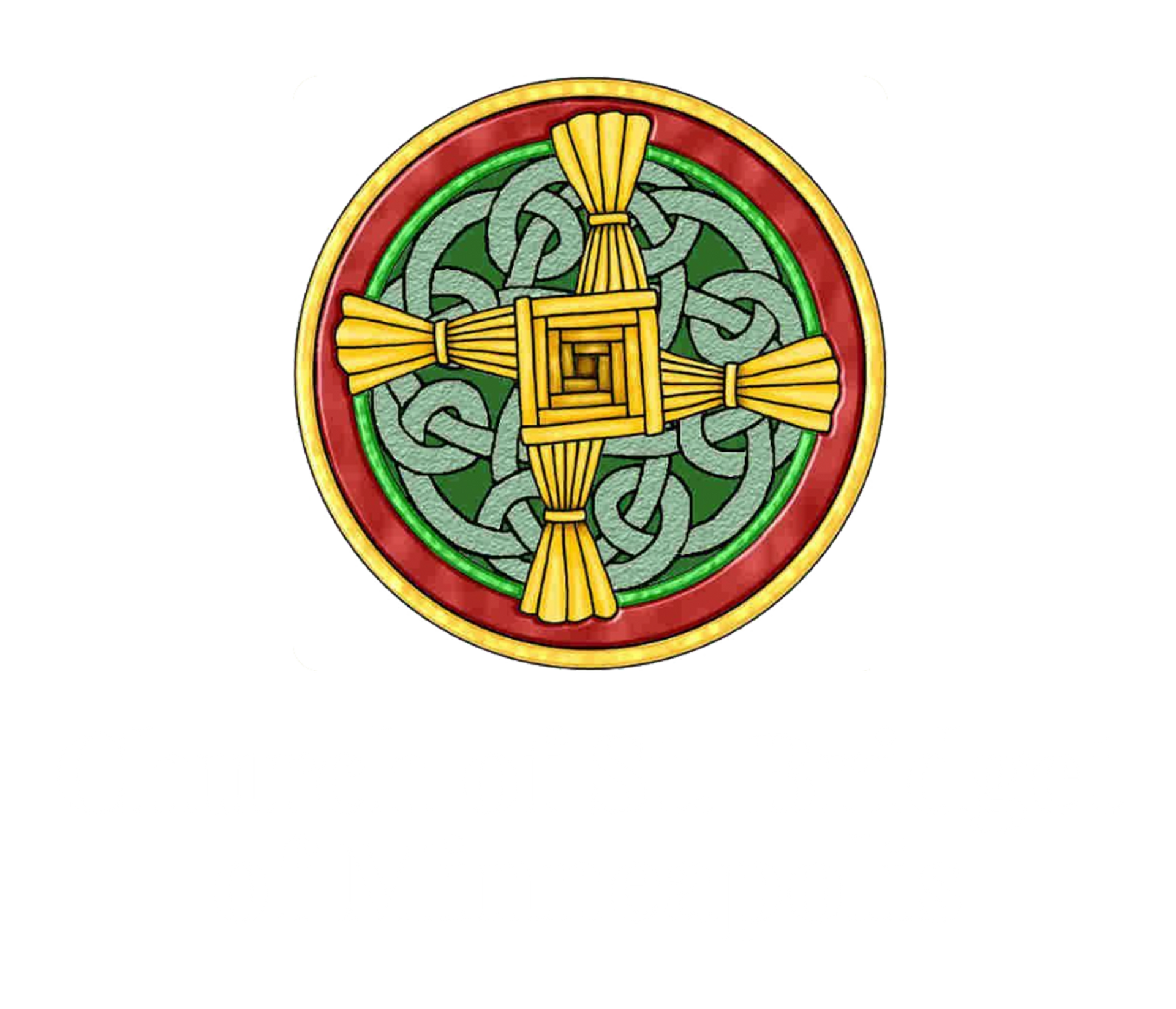
Saint Bridget’s cross is something that is seen as iconic, where we identify ourselves with our patron saint. Have you ever wondered about the story of St Bridget’s cross, and what the origin of that cross was?
Making a Saint Bridget’s cross is one of the traditional rituals in Ireland to celebrate the beginning of early spring, February 1st. The crosses are made of rushes that are pulled rather than cut. They are hung by the door and in the rafters to protect the house from fire and evil. According to tradition a new cross is made each Saint Bridget’s Day, and the old one is burned to keep fire from the house. Many homes have several crosses preserved in the ceiling, the oldest blackened by many years of hearth fires. Some believe that keeping a cross in the ceiling or roof is a good way to preserve the home from fire which was always a major threat in houses with thatch and wood roofs. Saint Bridget and her cross are linked together by the story that she wove this form of cross at the death bed of either her father or a pagan lord, who upon hearing what the cross meant, asked to be baptized.
One version goes as follows: “A pagan chieftain from the neighborhood of Kildare was dying. Christians in his household sent for Bridget to talk to him about Christ. When she arrived, the chieftain was raving. As it was impossible to instruct this delirious man, hopes for his conversion seemed doubtful. Bridget sat down at his bedside and began consoling him. As was customary, the dirt floor was strewn with rushes both for warmth and cleanliness. Bridget stooped down and started to weave them into a cross, fastening the points together. The sick man asked what she was doing. She began to explain the cross, and as she talked his delirium quieted and he questioned her with growing interest. Through her weaving, he converted and was baptized at the point of death. Since then, the cross of rushes has been venerated in Ireland.”